vrijdag 3 december 2010

Sold Fragments

Tuesday I sold my first 2 fragments, the rock with the biggest Kenya Tree and the rock with the 2 mushrooms on it. BvN from one of the forum I’m on wanted to buy them. He also has a Red Sea Max 250, but he is just getting started.
He started on 19 October 2010 with building up the aquarium and running it with water only. 2 days later he got his life rock which was placed the same day as well as added salt water. From that the algae began to grow as well as other life from the rocks.
On November 19 he added first life to the aquarium, 2 snails and a hermit crab and 2 days later some more snails and a Toadstool Leather coral. A week later he got some more corals and an anemone through the forums. By now his aquarium is pretty full already with many different corals, among them the 3 he bought from me. Here is a first view on how they look in his aquarium.

dinsdag 30 november 2010

Cleaning - End of Aiptasia?

Yesterday evening it was time for another cleaning round. As always cleaning is paired with trying to kill sea and majano anemones. The big sea anemone was first, and even though I’m pretty sure I hit him he moved back. Well first try couple of the majano anemones, but these are all hidden pretty good and are hard to reach, so I didn’t get all of them.
Then it was time for another attempt at the sea anemone, and each time he moved back a bit and then showed himself again…he was taunting me! Well I wasn’t going to let me got beaten by an anemone. So another attempt, and there went my syringe…or at least the tip of it. I could see it behind a rock, I needed to get it out since it was a sharp metal object. First moved the tube worm and then tried to get behind the rock, but trying to get there I bumped the rock noticing that it wasn’t supporting the rocks above like we thought! And this was the rock on which the sea anemone was attached!
So the next step was simple, get the rock out, pour boiling water over the spot where the sea anemone was located…and while I was at it remove some red hair algae. When everything looked pretty clean I moved the rock back into the aquarium and that should take care of the sea anemone plague!

After that the real cleaning started. Cleared a bucket with hair algae and some water :p. New water in the aquarium, and when that was done I decided to replace the first of 6 light tubes. I started with the front one, and within 2 weeks the one after that will be done. But for now only a 10k Kevin tube was replaced, but already this makes a huge difference.

vrijdag 26 november 2010

Cleaning november 2010 - An Update

Last weekend we cleaned the aquarium again, and considering the two birthdays we had I decided to just give an update on how everything is looking now.

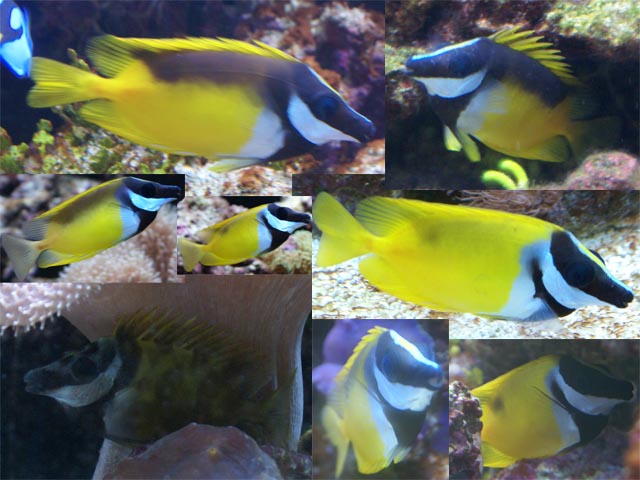
The fish are all doing fine, the birthday boy (Foxface) is still swimming around happily. He had a period in which he was more scared but now he is eating from my hand again, so everything is turning back to normal.
Only one that gives some concern again is the Blue Tang. I noticed a white spot on her body again, this time I was able to capture it on photo. She doesn’t seem to be bothered by it and still acts as normal, but I will try to get someone to identify this.
Corals are also doing fine, they are growing rapidly except for the Xenia. One rock is already empty now and the other rock seems to be losing branches too. Guess it’s just not meant to be for our aquarium. Maybe in a later stage I will give it another try, but for now I will just keep it at this.

The mushrooms have the most going on at this point. Many things keep happening with them and of course there are also my little experiments with them.
The oldest mushrooms are doing great, nothing wrong with them. The green mushrooms on my second mushroom rock are in a bit of trouble, one of them is being overgrown by the red mushroom and has moved a bit.
Then we have the red/brownish mushrooms (for whom I have to rethink the colour :p). They are growing everywhere now. I thought I lost most of them, but one of them appears now between the purple mushroom rock, another grows underneath the Soft Coral, one is between the purple mushrooms and the Ricordea mushrooms and I have one in a shot glass to attach to rock. So only one is missing now.
And then there are the experiments, the purple mushroom I cut loose from a rock has attached itself to a piece of rock together with a part of the red mushroom I cut in half. Both look great!
And another coral which is filling up the aquarium is the Kenya Tree. All fragments I intercepted are now attached to rocks and are growing up nicely. I started looking for new owners for them, so who knows what I can get for them :)
The Sea Anemone is still there, we tried to kill it again together with the Majano Anemones, but without much success unfortunately. The Majano Anemones only have one more left though, so that was successful.

maandag 15 november 2010

Cleaner shrimp first year anniversary

Past Sunday the Cleaner shrimp celebrated his first year anniversary in the Red Sea Max. He is currently the oldest Invertebrate in the aquarium and therefore the first to celebrate his first year anniversary.
In the early days he could be found a lot near the big toadstool we had back then, the cave behind it was his hideout, but also the toadstool was used as a hideout often. After the rebuild he found a new cave where we could see him all day, but unfortunately we had to rebuild again after that and the cave was gone. Now he hides somewhere underneath all the rocks far out of sight. Last few days he shows more often during feeding time but mostly we see him during the night.
His biggest hobby, harassing fish (cleaning actually), wasn’t very successful in the beginning. None of the fish wanted him to clean them. After some months couple of fish sometimes just let it happen (didn’t seem too fond of it though). Some time ago when we appeared to have white spot the Blue Tang offered herself voluntarily to the cleaner shrimp for a cleaning job.
He is a good cleaner, dead organism are his main priority. When I unfortunately damaged the Blue Sea Star he was the first to get hold of the lost leg/arm.
We hope to see him more often in the future and enjoy his fun behaviour, he is much fun to watch (as are most shrimps).

Foxface first year anniversary

The foxface celebrated his first anniversary in the RSM250 this Saturday. In the past year he has done great, it’s a great fish to observe. He changes colours depending on his mood, sometimes he is coloured bright yellow, sometimes with a black strip on his back and sometimes with brown/gray spots all over his body. Also sometimes the colour is more pale/white, mostly when he sleeps or is stressed. Also fun to observe are his spines which he flashes when he feels threatened.
In the beginning he enjoyed the presence of the big toadstool we had. He was always swimming around it and hiding underneath it. After the rebuild when the toadstool died he took refuge in the cave behind the Bulb Anemone.
He did give us some trouble with the rebuild. While we knew the firefish could jump he was the one who jumped out of the small aquarium and onto the floor. It didn’t seem to damage him luckily.
He is one of the few fish actually eating from my hand when feeding. But he also takes the frozen mysis and searches for algae during the daytime. He also feeds on the Sea Pearls we had a few of lately. The smaller ones disappeared rather quick, only the big ones remain for us to remove.

donderdag 4 november 2010

Fragment Tank

The fragment tank has had some adjustments. I already added an Eheim Compact 300 pump for circulation, however this didn’t seem to be enough for the 60 liter aquarium to get the water flow really going. So yesterday I added an Eheim Compact 1000 pump, which should be sufficient for 150 to 1000 liters per hour. This time I even had to turn it down a little because it was blowing way to fast at full capacity.
Another problem the tank had was the temperature, it was far too cold. So I have bought a Sera Precision heater 75w which is suitable for 50 to 75 liters.  And it did the job, because the water is now at an ideal temperature.
Then there was also a third problem which might have been the cause for corals not opening, and that was the lighting. Currently there was a 15W daylight lamp in it from Juwel itself, but this one didn’t produce enough Kelvin for corals. Instead I now bought an Arcadia Marine White Lamp of 15W and placed it instead of the old one. Only downside is that the aquarium only has one spot for lights, and ideal would be a combination with a blue light. But let’s see how the corals manage with this one first.
And then I also done some experiments. I needed to clean a rock from a sea pearl that was located on it, this was the rock with mushrooms and Xenia. Since we already have many mushrooms in the RSM I decided to see if I could get one lose for the fragment tank. Using a sharp knife I tried to get the foot to let go of the rock. While doing this the Mushroom started sliming like crazy, guess it’s a way of defending itself. But in the end it seemed to have worked and I know have a purple mushroom in the fragment tank.
Second experiment I wanted to do was fragging a mushroom. I still had the Red Mushroom in the fragment tank and decided to use this for fragmenting. Using the same sharp knife as before I cut the mushroom in half, straight trough the foot and mouth. Both parts are now in the fragment tank and we will see how they recover.
So the current inhabitants of the fragment tank are a Kenya tree, small dark brown mushroom, a purple mushroom, 2 half Red Mushrooms and 2 Sea Stars. Next to them there are a lot of broken pieces of rock, all from the former Toadstool rock. I did move the biggest part to the RSM for gaining some bacteria and turning into a life rock instead of only having dead rocks in there.

donderdag 28 oktober 2010

Extra aquarium

Yesterday I made our second aquarium ready, the one that was our fish tank during the rebuild and later became quarantine tank for the Toadstool coral when it was in bad shape will now function as a fragment tank. Reason for this is because our newest Kenya Tree is throwing around new fragments in high speed. We have one settled on a small rock, later I put two others in a small glass in our RSM with some rocks underneath, but then we also got a mushroom loose and I didn’t want to put them together. So I decided to rebuild the 60 litre aquarium.

The pump and filters are removed because of the polluted water from the Toadstool. I bought a new small pump, an Eheim 300 pump, for circulation. The pump should be able to pump 300 litres per hour, but it doesn’t seem enough. I filled the bottom with 3 litres of sand for bacteria to move in and the rest is running on water from the RSM combined with some newly made salt water. My wife smashed the rock on which the Toadstool used to be to pieces which are now scattered across the sand for corals to attach to.

Yesterday evening I also noticed another piece of Kenya Tree ready to depart, I took it of and put it in the fragment tank, so it is the first inhabitant for this tank. Corals will only remain there until they attach to a rock, when they have done so they will move to the RSM until they find a new owner.

I am thinking about putting in a heater since the water seems to be a bit cold still…but I’m not yet sure about this. Also something I am thinking about is moving any Asterina sp. I find in the RSM to this aquarium. For as far as I saw only few are aggressive against corals, but I didn’t notice the ones in my aquarium bother with corals. And the others eat algae, detritus and dead/dying organism. Since they are easy to keep (most of them are still alive after throwing them into a bucket with water) they might be a great addition for this aquarium in keeping algae and detritus to a minimum.

vrijdag 22 oktober 2010

Capnella Imbricata

Scientific Name:     Capnella Imbricata
Classification
:         Soft Coral
Common Names:    Kenya Tree Coral, Cauliflower Soft Coral


Description:
The Kenya Tree Coral, also referred to as a Cauliflower Soft Coral, Nephthea, or Nephthya, is similar to the members of both the Litophytonand Nephthea genera. It lives in a wide range of the Indo-Pacific. It has a thick trunk, like a tree, and many branches giving it an arboreal appearance. It is not normally considered a threat to hard corals, but may itself be disturbed by their presence.


Natural Environment:
They can be found in de Indo-Pacific seas.  


Care:
Care level: 
Very hardy and easy to keep coral. Adjust to almost any condition

Lighting: Medium to high lighting


Water Current:  Medium to strong flow

Temperature: Does well within a range of at least 72º to 78º F (22 º to 27 º C). 

Aggressiveness: Semi-Aggressive, may damage other corals close to it

Feeding: Gets his food through Zooxanthella/Light but depends most on planktonic feeding 

Supplements: No special requirement are noted, but may benefit from marine snow or phytoplankton.

Tank Positioning: They can be place anywhere in the aquarium.

 Propagation: Can be propagated by cutting of a branch. In nature they inflate a part which then detaches.

In my aquarium:
For me it started on December 14 2009, it was one of my first corals back then, a green coloured Kenya Tree. In January we moved it to another location because it wouldn’t stand up straight, maybe to much flow in its first location. That very same month during cleaning we found out it attached itself to a neighbouring rock, and with the cleaning we damaged it. Same thing happened again one month later, but the Kenya tree just kept growing.
In April the whole aquarium was covered with a brown blanket, also the Kenya Tree had some on him. It was the time we decided to go for a rebuild.
Next month we started the rebuild. The Kenya Tree was still attached to two rocks so we had to be careful not to damage it too much.
After we put the rock back the Kenya Tree didn’t look very good. Also the small rock it came on was becoming a bit of a hazard to the other life forms.
We decided to cut loose the small rock. Having done so a small part of Kenya Tree was left on the rock. We decided to leave the rock in the aquarium, just to see what might happen with that small remaining piece. Good thing we did, because one month later a small branch began to evolve, a fragment was born.
Shortly after that we noticed a part of the first Kenya Tree inflate itself. After asking on some forums we found out this was the way the reproduced. However, this part deflated itself after a while.
It was august 2010 and we had to rebuild again, this time because of a fish which needed to be sold. Both Kenya trees moved because of this and found a new place where they are now grown much larger then they where.
In September 2010 we bought a second Kenya Tree, this one came with a rock with Cabbage Leather Coral around it. This Kenya Tree found a nice central-top position in the aquarium.
The new Kenya tree also inflated a couple of times, first time I just left it just as I did with the other Kenya Tree, but at the end of September we noticed that it was really true, the inflating was its way to reproduce. September 30 2010 we found a piece of Kenya Tree growing from underneath a rock at the bottom. This means we now have three Kenya trees in the aquarium.
October 20 2010 I noticed two other parts being inflated, when looking closer I also saw that they where almost lose from their host. To prevent more Kenya Trees from spawning randomly around the aquarium I decided to remove the inflated parts and put them in a small glass with some rocks so they could attach there. Two days later one of the pieces was already attached to a small rock, and the other attached to the glass.

More information:
For more about the Kenya Trees in my aquarium and their history see the following links:
Kenya Tree Coral (14-12-2009)
Kenya Tree Coral Fragment (14-05-2010)
Kenya Tree Coral (18-09-2010)
Kenya Tree Coral (30-09-2010)
Kenya Tree Coral Fragment (20-10-2010)

Marine Ich

Monday evening I noticed three white spots on the body of our Blue Tang. First guess and fear is Marine Ich so reason to get as much information on it as possible.

Tuesday started searching my regular forums for ways to treat Marine Ich, during this search I found out that Tangs are some of the most vulnerable fish to ich. However, the Blue Tang is a very strong fish and has a high ich survival rate. One of the members from tropischzeeaquarium.nl started a post in which he complaints about the lack of information on how the disease evolves. He also has a Blue Tang that had three spots, sometimes it becomes less and sometimes it’s worse. His Blue Tang eats correctly and looks fine. He feeds Artemia that has been soaking in a bowl of water with garlic pieces. His only notice was that the Blue Tang was a bit jumpy (scared easily).
All this sounds pretty familiar, our Blue Tang also has three spots now (don’t know if they become less or more) but eats normally and looks good. Also our Blue Tang is a bit jumpy and on top of that he is bullied around a lot by other fish. Maybe the treatment used by PGT is something worth trying.
The response to this post by roelsil, a user that seems to know a lot of seawater aquariums and also has a very nice aquarium himself was that he thought there wasn’t much going on. He said the Blue Tang is sensitive to ich, but also resistant to it. He also had a Blue Tang that had ich when they did maintenance on the aquarium because of stress, but after a while it would become less. Only when loads of spots appear there was a reason to worry.

This is somewhat a comfort, but what if you do want to treat against Marine Ich. On tropischzeeaquarium.nl there are many topics about Marine Ich. Two users used a product from Salifert called Stop Parasite. It can be used in an aquarium with corals but I did found a warning to dose carefully. If combined with a month rest and some garlic in the sump it should pass away without “much” damage.
One person left his light on constantly for 3 days and got the Marine Ich out. Downside to this method was that his tank was in chaos and he didn’t safe all his fish.
Another solution, found more often, is UV-c light. When left on 24 hours a day 7 days a week it kills Marine Ich and when combined with Ozon it gives your crystal clear water which makes the effect of the UV-c even better.

And then there was also a discussion topic on tropischzeeaquarium.nl about what people do to fight Marine Ich. From this I concluded that in an early stage garlic works fine, put it in the sump and cut some through the food and give the whole aquarium some rest and it should be gone. The UV light is mostly used to prevent ich more then to cure ich. Also when there are a lot of particles floating in the water the UV light might not be effective enough. Also the Stop Parasite is mentioned once in the discussion, but this was at a point where already fish where very weak, not really proven to be a good solver.
In an advanced stage ich is treated by either catching the fish and putting it in Quarantine, then treat the tank with copper sulphate. Then after the ich is gone slowly get the fish used to normal water again so he can rebuild his slime coat. The copper sulphate damages the slime coat of the fish, so when inserted back in a tank with corals the sting cells of the corals may kill the fish in the end.
Another way that was described is by putting the fish in a sweet water bath for max 10 minutes (more would kill the fish). It seems that the osmosis pressure of sweet water kills ich.

Many solutions and options, but what is ich exactly. Many sites can be found on this and some interesting articles can be read about what it is, what it does and how it lives. Now I can copy entire articles, but if you are really interested I will put the links below. However, in short on what it is and how it evolves.
Ich has four stages in its life cycle, it needs a host to survive and evolve through these four stages. The first phase (maybe not first, but that is a chicken/egg discussion) it is called a theront. Theronts swim around the water searching for a suitable host, if they don’t find one in 12 hours they die. However, when one of them is successful it goes into the feeding stage, known as Trophont. In this stage the parasite feeds on tissue fluids, this is also the moment in which you can see distinctive white spots that form around the parasite. In this stage treatment is useless since the Trophont is to well protected against any treatment. Only when in a free-swimming stage the parasite is vulnerable.
The Trophont will grow till it reaches up to 3 – 5 mm, at this point the Trophont will leave it’s host. It will then attach to any type of substrate and turns into a thick skinned Cyst called Protomont. Inside the Cyst several 100 new Theronts will form that will then spread out to restart the life cycle.

One part I thought I just needed to copy and paste is from reefsanctuary.com and was written by a user called leebca. In here he/she describes Subjective and Non-Subjective Observations, Claims, and Common Myths. Many of these points say that most of the things mentioned on the forum don’t offer a solution, just a relieve.  

1. Some Tangs seem more susceptible. True.  Their mucous coatings are reduced in thickness and composition. They swim up to 25 miles a day in the ocean in search for food so maybe Mother Nature provided them with this as a means of 'escape.'

2. It goes away on its own. Untrue. Only visible at one stage IF it is on the body or fin of the fish. It’s the life cycle. If it was once seen, then it hasn't gone away -- it's just not visible to the aquarist.

3. It goes away with a ‘reef-safe’ remedy. Untrue. This is one of the biggest and most 'dangerous' of the misrepresentations in the hobby. The aquarist thinks everything is okay when it isn't. What usually has happened is that the parasite has killed the fish it will kill and the rest have developed a resistance or immunity. The parasite is still in the aquarium, possibly infecting the gills of the fish where it can’t be seen.

4. It was gone then when a new fish is added, it is there again. Not true. See 3. It wasn’t gone or the new fish brought in the disease with it. A new addition to an aquarium can be the stress which triggers the other fish to reduce their defense or immunity, thus allow the parasite to 'bloom' to the point where the infection is now visible to the aquarist.

5. The fish lived the last outbreak then died during the second or subsequent outbreak. Can be true. The fish had a resistance or immunity that it lost.

6. It was accurately diagnosed as MI spots, then never showed up again. It wasn’t MI or the fish quickly developed an immediate immunity or resistance, or the fish is still infected in the gills.

7. MI can ‘hang around’ almost unnoticed with just a body spot now and then because it often resides just in the gills. True. So ‘it is gone’ after ‘it was here’ is very unlikely.

8. Aquariums always have MI. Untrue. MI can be kept out of an aquarium. Just quarantine all fish and don’t let non-quarantined livestock get into the aquarium. After keeping thousands of marine fishes, my home aquariums have been free of MI since 1970.

9. Fish always have MI. Untrue. In the wild they often show up to 30% infected (or more) but the wild fish survive minor infections. In the tank the parasite can 'bloom.' In the tank the fish can't get away. The combination of bloom and no escape will overcome the fish. In capture and transportation the fish can share the disease and thus many wild caught marine aquarium fishes do have this parasite, but not all.

10. Like 9. a fish can't be made to be totally rid of MI. Untrue. All marine fish can be cured and rid of any MI infection.

11. Just feed the fish well and/or feed it garlic and it will be okay. Untrue. I compare this approach to this one: "Granny has pneumonia. Let's keep her home rather than take her to the hospital. We'll feed her well with chicken soup and vitamins."  Nutrition, foods, vitamins, etc. don't cure an infected fish. An infected fish is sick and is being tortured by the itching and discomfort. It might pull through and obtain Resistance or immunity (see above) but while you sit comfortably in your home, the fish is being stressed by having to contend with a parasite. Don't let this happen to the fish. Cure it!!

12. A new cure has been discovered. Unlikely. If the aquarist thinks they have found a new cure, then have it researched and independently tested. It's easy and cheap. If it is as good as the above 3 then the professional veterinarians, private and public aquariums, fish farms, and I will use it. The aquarist needs to keep the perspective of how devastating this parasite is not to just the hobby but to the whole fish farming industry. Any new way of 100% treatment will make headlines! 

13. If the MI can't always be detected, then why bother with a quarantine procedure? In the confines of a small quarantine and being there for no less than 6 weeks, the MI parasite will make itself known because the fish is weakened and the fish can't get away from being re-infected by multiplying MI parasites. In other words, the quarantine procedure instigates a 'bloom' of the parasite which will make it visible to the aquarist.

14. All white nodules fall off the fish and move on to the cyst stage. Untrue. It has been discovered that, on very rare occasions (why we don't know) the white nodule will encyst and rupture while still on the fish.

15. UV and/or Ozone kills MI. Ozone doesn't kill all parasites that pass through the unit, nor does the water treated with ozone kill the parasites. UV only kills the parasites that pass through the unit. Not all MI parasites will pass through the unit, so the UV will not rid an aquarium of MI. A UV can help prevent a 'bloom' of the parasites however, and thus help in its control. UV is not a cure nor a preventative measure for MI. 

16. Spots are MI. Untrue. Probably one of the most problematic causes for rumors and myth-information in the hobby is assuming the spot is Marine Ich when it may be one of another few dozen other parasites or conditions (e.g., pimple-like reaction to infection) that look like Marine Ich. The mis-diagnosis is often the cause for claims of what cured MI, when the fish didn't have MI to start with.

17. My LFS quarantines their fishes for 2 weeks and I only buy them to be sure they are healthy and free of MI. Have you been reading the above? The 2 weeks is not long enough. Was the 2 weeks in isolation or is the fish's water mixed with other fish's water? Seeing is not believing, right? LFS employees don't have time to closely observe and study the fishes they have in stock, for a full 6 weeks. The truth is out there. . .Trust no one.


Wednesday I checked again, wanting to make some pictures to see if it was Marine Ich or not and guess what…not a single trace left. No visible spots, no heavy breathing, nothing out of the ordinary. The big question now is, was it MI? If it was, is it still there but no longer visible? I did start adding garlic to the fish food, maybe because of this the Blue Tang got more resistant to MI and made the visible part disappear.
I’m going to continue with the garlic and maybe add an Ozone and UV filter. Guess it can’t hurt to do this.

For more information check

donderdag 21 oktober 2010

Plagues and unwanted guests

An update mainly on plagues and unwanted inhabitants. Let’s start with some algae!

The Sea Pearls seem to be gone now, guess the Foxface does eat them, or we have another inhabitant who enjoys this algae. Only one bubble was seen on the rock with Xenia en Mushrooms.

Unfortunately we now have a lot of red hair algae, which is coming to the point that I think we should do something about it. Expect a topic on it sometime soon on the forums.
Then there is the unwanted invertebrates. The sea anemones seem to be under control with the peppermint shrimps, haven’t seen any new ones yet. Unfortunately the old ones are still there, and growing larger each time. Maybe next weekend we will try something, but everything depends on something I will mention later on.

The Majano Anemones have one more in the colony, they started out with three, my wife killed on of them, but now there is one next to the Xenia all of a sudden. Same as above, maybe next weekend try to kill it.

Then a “new” inhabitant are the Asterina starfishes. We keep fishing them out each time but they still keep coming. Also on these little bastards you can expect a topic on the forums soon, first need to gather some more information on them.

And then the last plague is one that I am absolutely not happy with! Our Blue Tang seems to have white-spot parasites. More information on how and what will come soon when we start treatment and when I know more about it. Unfortunately or luckily when I wanted to take a picture there was no spot to be seen.
But there is also some good news for the corals. The striped mushroom I got a while ago has attached itself to a small piece of rock I put in a small glass. I now put it where I wanted it and it can’t blow away anymore because the rock it to heavy :)
Monday I also noticed one of the small brownish mushrooms I got together with the striped one appeared all of a sudden next to the soft coral. Also it seems one of them is in between the purple mushrooms above the first one spotted. Looks like we have three of them again now :)
The new Kenya tree had 2 blown up pieces on it. When I looked at it more closely couple of days ago I noticed they where almost unattached from the host. I removed both parts and put them in the glass where the striped mushroom was in before. I don’t know if this is ideal for them, so work started on a fragment tank. One of them already attached to a small piece of rock, the other one attached itself to the glass. Here is the one I already got attached to the rock.
Monday I bought a new pump for the fragment tank, the small 60 liter aquarium will only have couple of small rocks in it and I will dump all lose corals in there for them to attach to some rock. When they have attached I think of putting them in the Red Sea Max again so they can get some good conditions to grow before they get sold/traded or get another destination.

dinsdag 12 oktober 2010

Temperatures and the Red Sea Max 250

One of the things that isn’t very good on the Red Sea Max 250 is the heat control. It has much trouble getting rid of the heat of the lighting and environmental heat, most people buy a cooling device to take care of this, but in some cases, like our, this is just not enough.

The problem first came to light when we had our first summer with the RSM, luckily the system only had life rock in it back then, but the temperatures in the house got to a 30 degrees Celsius, and inside the aquarium even higher. Now I must add that our apartment is always warm, we live on the 7th floor of a 9 floor apartment complex and because of other animals we have we can’t open all the windows and doors against each other.
But after that summer we bought ourselves a DC-300 cooler and temperatures stayed around the 25-26 degrees Celsius. Then one day one of our cats closed the door of the RSM cabinet and the cooler couldn’t get rid of his heat. Since then it still works but makes a lot of noise, the door has been removed just to be sure.

Now last summer the cooler had a hard time, it was its first summer and he couldn’t get the temperature down to 25 anymore. However, the temperature rarely went up above 26 degrees Celsius. So all and all it didn’t do that bad, but then last weeks we noticed the temperature go up to 27 degrees. Outside it isn’t so warm anymore, but still the temperature kept going up to 27. Then the cooler did his job and made it go down to 25 again, but within minutes we where back at 27 again. Time to do some experimenting!

First thing I did was open the hood, turn of the lights and use a table fan to blow over the water surface. Temperature dropped in no time without the cooler even bothering to start. Time for the lights to go back on again!
This second step didn’t change anything, but I had to turn down the fan a bit because temperature dropped below 25 degrees all of a sudden.
Next step I closed the hood except for the small piece on the front, temperature got to 25 again but didn’t go up…it was stable at 25 degrees Celsius. Conclusion, a table fan and partially open hood regulate temperature better then the cooling system.

I have kept my eye on it for couple of days, and one thing I noticed is that I have to turn of the fan at night, because with the lights out the temperature drops too quickly. Also the evaporation of the water is quicker in this way, but this is the reason it stays cooler I guess.  

maandag 4 oktober 2010

Firefish and two Peppermint Shrimps added

Past Friday we got a call that our ordered Firefish had arrived. When I was there to pick it up we also found that they had a bunch of peppermint shrimps, so we also bought 2 of them. One has eggs, so I’m curious how that will go and if they survive. But our main hope is that these two survive longer and will kill the Sea Anemones.
The new Firefish
The bigger pregnant Peppermint Shrimp
The small Peppermint Shrimp

We tried killing the Sea Anemones again with boiling water, just like we tried to kill the Majano Anemones. We got a couple of Sea Anemones and one Majano Anemone. Still too many left unfortunately.

The Salarias has some problems with all the changes and things that took place. He stayed underneath a rock the whole weekend and was breathing quickly. Guess we need to give the aquarium a bit of a break again.

And then we have our newest Coral, one we didn’t expect but was suddenly there underneath a rock which has been in the aquarium since the early start. My guess is that he detached from the latest Kenya tree. It had a bubble on it like the oldest one, back then I asked and someone said it was splitting. Then it didn’t seem to have happened, this time it probably did.

donderdag 30 september 2010

Discosoma or Actinodiscus sp.

Scientific Name:     Discosoma and Actinodiscus sp.
Classification
:         Soft Coral
Common Names:    Mushroom coral

Description:
The Actinodiscus Mushrooms are also referred to as Mushroom Anemones and Disc Anemones. They were previously in a genus called Discosoma. These invertebrates display a wide variety of colors, textures, and patterns. Some are solid colors, whereas, others are striped or spotted. Some are smooth and others are bumped. The great variety together with the fact that they are easy to keep make them a great addition to any aquarium.

Natural Environment:
They can be found in de Indo-Pacific and South Pacific seas.  


Care:
Care level:  Mushrooms are easy to keep and tolerate almost any tank setup

Lighting: Will tolerate very low light levels, but does best under moderate lighting.  Very intense lighting may prevent the coral from opening fully.

Water Current:  Mushroom corals prefer low to medium water motion.

Temperature: Does well within a range of at least 72º to 84º F (22 º to 28 º C). 

Aggressiveness: Low.  Have never noticed it attacking nearby corals. Mostly other corals win from the mushrooms.

Feeding: An Actinodiscus Mushrooom receives some of its nutritional requirements through the photosynthesis of the symbiotic algae zooxanthellae which it hosts. It also feeds on other nutrients and particulate matter and benefits from additional food in the form of micro-plankton or brine shrimp fed to each polyp of the colony. 

Supplements: No special requirement are noted, but may benefit from iodine supplementation.

Tank Positioning: They can be place anywhere in the aquarium but most people place them near the bottom because they are not very light demanding. They are great for filling gaps between larger corals.

 Propagation: Not tried it yet, but it is said that they are easily propagated by cutting individual polyps into several pieces.  These can be placed on a gravel bed with low water flow and will attach themselves to pieces of gravel. They can then be superglued to a suitable substrate such as a reef plug.

In my aquarium:
For me it started with a little red mushroom I got for free at our aquarium store 14 December 2009. I put it on a rock and after a couple of weeks it had attached there. It was at that point that I wanted to try and create a rock filled with all sorts of mushrooms.

On 6 March 2010 I got another one a greenish looking mushroom which I dropped next to the red one. It didn’t take long for him to settle there as well and the rock already had 2 mushrooms (and a lot of Halimeda algae).

The aquarium got rebuild, all corals where without light for 3 whole days and waited in a bucket. When I placed the mushrooms back it was as if nothing ever happened to them. Only difference was that the rock was grey and had no more Halimeda on it, but the mushrooms where doing fine.

On May 27 2010 I got in contact with someone on http://www.zeewaterforum.info/ who had a bunch of blue mushrooms for sale. I found one lose and bought it together with some other small coral fragments. It was the third coral for my coral rock. Unfortunately it became harder to keep them in place so they could attach to the rock. 

Not long after I found 3 lose mushrooms in our aquarium store which I got for free. The first rock was pretty full so we decided to move my project to another rock. Again the attaching was hard and one of the mushrooms got blown away never to be found again.

On the 10th of July I came into contact with someone from http://www.zeewaterforum.info/ again. This person said he had many mushrooms for me, and he did. We got 4 rocks with mushrooms, one being a very small rock with a red mushroom which we place with the 2 remaining green ones. The other was a rock filled with purple mushrooms and two rocks with buttons and a mushroom in between.

By now we had many mushrooms all in different place with different conditions and all looked different. Couple of days later we found our first two mushrooms had split. A small red and a small green mushroom appeared underneath the big ones. In the beginning they look a bit transparent but it is only a matter of time till they gain full color.

In august we had to do a little rebuild again to catch a fish, none of the mushrooms had any trouble with that except for the red mushroom that was attached to a rock with buttons. He seemed to have itself attached to the other rock as well and while shifting rocks the buttons broke lose from the mushroom. The mushroom is still doing fine, as if nothing ever happened to him.

When we got back from vacation in September we noticed many corals had grown, just like the mushrooms. The oldest one gained another little one, and the blue mushroom also gained 2 small ones. The blue one however has a lot of blister like spots on it, no idea yet what it is. Also the Sea Anemone next to it seems to bother it a lot.
The purple mushroom that came with the buttons has a hard time to, it is being overrun by buttons but also seemed to have separated.

September 18 2010 we bought many new corals again, one of them being a rock filled with Xenia and purple mushrooms. The Xenia doesn’t seem to bother the Mushrooms at all, the starburst polyps below however seem to bother them a lot.

And 10 days later we got another batch of lose mushrooms from our aquarium store. One being a striped one, bit bigger then usually. And the others are 5 small dark red or brown mushrooms. Of the last 5 only one is still visible, but that one seems to be stuck now, so that’s good. The striped mushroom is still all over the place.

More information:
For more about the mushrooms in my aquarium and their history see the following links:

Other good articles: